Welcome to Cannabryl
Licensed to Manufacture Medicinal Cannabis Based Drugs
How is CBD Absorbed in the Body?
When you use any CBD product, it must be transferred from the administration site into the bloodstream. From there it is transported throughout the cannabinoid receptors (CB1 & CB2) in our endocannabinoid system and other non-cannabinoid receptors like our serotonin receptor (5-HT1A). There are two important concepts to understand here:
The path that any CBD product is consumed or applied to the body is defined as the route of administration. This has a direct effect on the uptake, distribution, and elimination of the compound. In practical terms, the way you consume a CBD product will govern how quickly it will come on, how much of the substance becomes active in the body, and how long the effects will last.
The process of absorption is the transfer of CBD from the site of application into the bloodstream. This concept is called bioavailability but could also be referred to as simply the effectiveness. This term is defined as the rate and total amount of a product that has an active effect once consumed or applied. This concept is measured as a percentage. This number represents the total amount of a given substance that was absorbed and put to active use - i.e. 10%. This is an important concept because many popular routes of administration suffer from low bioavailability.
CBD Products by Method of Ingestion?
There are many popular methods of consuming CBD oil, with specific products created for each application. Below we take a look at the five primary methods of CBD administration and the related products for each. As a user, you'll want to choose the type(s) of products you purchase based on the factors outlined below:
Sublingual: Concentrates, Tinctures
Sublingual application is when a tincture is administered under the tongue. The solution is held there for 60-90 seconds before being swallowed. This method carries with it a slightly higher bioavailability than simply swallowing these same compounds.
When CBD oil is held under the tongue, some of the hemp extract compounds are directly absorbed into the mucous membranes. The remaining compounds that are swallowed, then pass through the liver as any swallowed product does. The compounds absorbed by the mucous membranes absorb more rapidly and effectively, reaching the bloodstream without being broken down by first-pass metabolism.
Users who are not comfortable with the flavor of cannabis may be turned off by sublingual administration. There are some companies out there using flavor additives to mask the cannabis taste. Many edibles contain sugar and preservatives, so if you want to avoid additives, you might want to try a sublingual product. These are designed to be absorbed under your tongue. They include pure extracts OR tinctures. Letting the product absorb under your tongue rather than subjecting it to the digestive tract preserves more of the CBD, and you’ll feel results faster. There are lots of small capillaries which absorb the medication immediately and merges with blood. If taken via digestive system it takes time for the medicine to reach blood, and chances of costly medicine flushing out of system are higher.
Oral Ingestion: Capsules & Edibles
The most common method of using CBD is to take a product by mouth. This means swallowing capsules or eating CBD containing edibles. When CBD is swallowed, it enters the digestive system before being absorbed. The hemp extract in the product must pass through the portal vein into the liver which metabolizes the CBD and other molecules. This process is called first-pass metabolism.
The big issue with this method of consumption is that the enzymes in the liver reduce the concentration of the CBD compounds before passing on what remains to the bloodstream. This passage through the liver reduces the efficiency of CBD absorption. One study reported that a dismal 6% bioavailability was observed when CBD was ingested directly.
Bioavailability Issues with Oral Products
This issue of low bioavailability for oral products has driven the CBD industry to find solutions which increase the amount of a product that is absorbed by the body, reducing waste. The following methods are commonly used:
Carrier Oils
Cannabinoids like CBD are fat-soluble. This means they break down to be stored in fat - not water. When consumed with fat, these compounds can be more effectively processed by the body. For this reason, many products utilize an oil carrier that is mixed with the hemp extract.
Today, MCT oil is the most commonly used carrier. By combining CBD-rich hemp extracts with MCT, your body burns these fats and puts them and the cannabinoids they hold to use immediately. The result is a marginal increase in the overall amount of CBD and other cannabinoids absorbed by the body.
Products utilizing this method are commonly traditional oil-based formulas. They are low cost, easy to make, and have dominated the early years of the hemp market. The downside is these products don't increase bioavailability much. Luckily an answer to this significant problem has arrived.
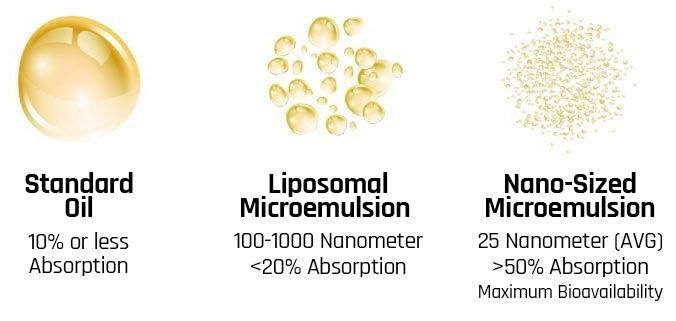
Significantly Increased Bioavailability with Water Soluble CBD
Significant technological improvements in the area of hemp extract processing have created a new breed of product which addresses bioavailability issues. Products often called 'water-soluble' have entered the market. These products use new technologies to break up the oil particles into tiny pieces and then suspend them in a liquid form.
The result is greatly increased surface area and more ready absorption by the body due to the tiny particle size. The result is anywhere from a 200-500% increase in effectiveness compared to traditional oil-based products. The duration of the effect may be slightly shorter. You'll find these products utilizing various technologies like liposomes and nanoemulsions. This technology has been studied over the last 20 years with positive results and is utilized in many other oral supplements and medicines.
These water-soluble products are more costly to produce, but thanks to a maturing industry they are becoming widely available. We sell both water-soluble capsules and water-soluble tinctures right here at Indogenix Biosciences.
Suppositories

This final application method is by far the least popular of all 5 we cover here. Your average person is going to choose to swallow or inhale medicine long before they choose a suppository. Despite this, suppositories are proven to be highly bioavailable and thus a highly effective means of using CBD.
Using a CBD suppository has the best of both worlds when it comes to onset and length of effects. These will show noticeable effects after less than 15 minutes and the effects can last for nearly 8 hours - longer than all other forms of taking CBD.
Topicals
CBD topical are designed to be applied directly to the skin. You can find CBD-infused lotions, balms, creams, salves, and transdermal patches. Topicals are a great choice when it comes to treating localized pain or skin conditions like eczema in a discreet fashion. A 2015 study (https://onlinelibrary.wiley.com/doi/10.1002/ejp.818 ) done on rats found that CBD gel applied to the skin greatly reduced joint swelling — promising results for people with conditions like arthritis.
While studies on topicals haven’t given an estimate of bioavailability, we do know a couple of things: Topicals aren’t subjected to the first-pass effect, so they’ll provide concentrated relief to a particular area. The permeability of your skin is pretty poor relative to mucous membranes, like sublingual tissue. That means when using a topical product, you’ll want to choose one with a high amount of CBD and apply it generously. Using a product that contains additional analgesics including menthol, camphor and capsaicin may bring even more therapeutic potential to the mix.
Topical: Lotions, Balms, Salves & Patches
Administering cannabidiol directly to the skin is another popular way to utilize hemp extracts. There are a wide variety of lotions, balms, and salves available to serve this need. These products are designed to alleviate symptoms including aches and skin issues. This method of application is viable because there are cannabinoid receptors found in the skin.
Anecdotal feedback has caused topical CBD products to become increasingly popular. Products range from at-home balms and salves to professional-grade massage oils. With an understanding of the various ingestion methods available, it's time to decide which CBD product is right for you. This decision will vary from person to person based on your needs and how comfortable you are with each administration method. For example, you may be fine with vaping but aren't happy with the short duration of the effects. Sublingual may be preferred for the quicker onset and long duration, but the taste isn't something you can handle.
No matter your situation, our advice is to try different products until you find the one for you! Use the following chart to compare the onset and duration associated with each application method:
| Method of Ingestion | Bioavailability | Onset |
|---|---|---|
| Oil-Based Oral (Capsules, Edibles) | Lowest | 30-90 Minutes |
| Oil-Based Sublingual (Tinctures, Sprays) | Mid | 20-40 Minutes |
| Water Soluble Oral (Capsules, Edibles) | High | 15-45 Minutes |
| Water Soluble Sublingual (Tinctures, Sprays) | High | 10-20 Minutes |
| Inhalation (Vape, Smoke) | High | 2-5 Minutes |
| Topical (Lotions, Balms, Patches) | Low | 60-90 Minutes |
| Suppositories | High | 10-15 Minutes |